Customer Service Chatbots
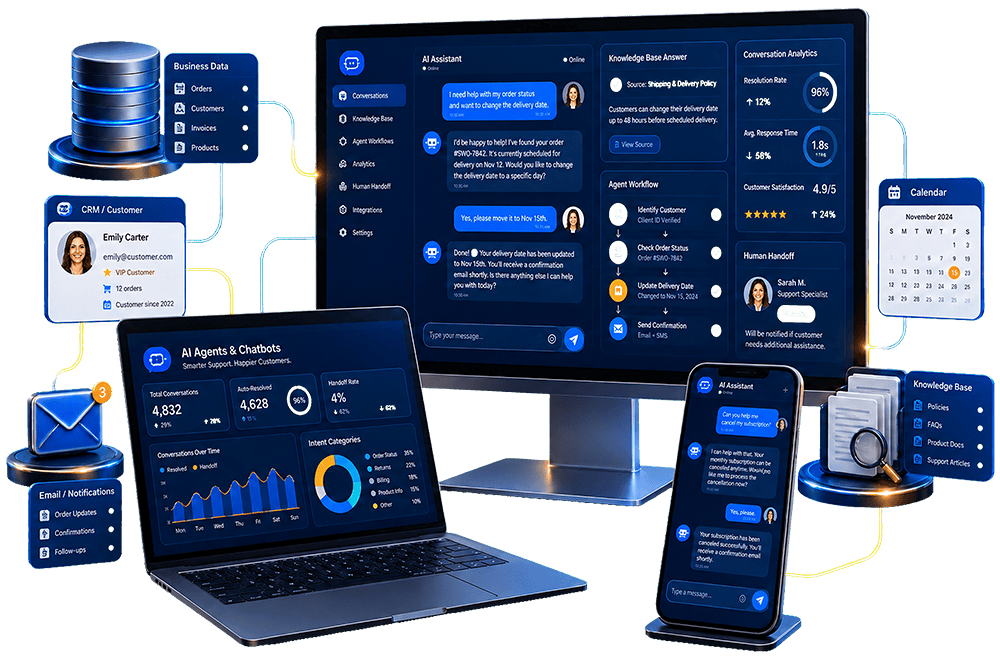
We develop website and application chatbots that can answer common questions, explain services, help users navigate content, qualify inquiries, collect information, check appropriate account or order details, schedule next steps, and route complex requests to your staff. The scope depends on your business, systems, and desired customer experience.
Internal Knowledge Assistants
An internal AI assistant can help employees find policies, procedures, product information, training materials, project documentation, and other approved company knowledge through natural-language questions. Instead of searching across folders and long documents, team members can ask for the information they need and receive a concise response grounded in designated sources.
Internal agents can help users follow repeatable processes, prepare drafts, summarize permitted information, or identify the next step. Permissions and source boundaries are planned around operational needs, departments, and user roles.
Workflow and System Integrations
ance your agent's capabilities with our in website chatbot development, AI business automation to revolutionize your processes. By employing advanced AI agents, create custom solutions that bridge the gap your assistants and existing systems. This integration allows for efficient data retrieval from customer databases seamless calendar management, and of support tasks through email platforms. Our approach ensures reliability thorough permission protocols, detailed, and robust error management. Let us simplify the complexities, so your business operations stay efficient and productive.
Testing, Guardrails and Continuous Improvement
AI assistants require structured testing before and after launch. We evaluate common questions, incomplete requests, unusual wording, unsupported topics, conflicting sources, sensitive situations, tool failures, and escalation paths. Guardrails define what the agent should answer, what it may do, what information it can use, and when it should stop or involve a person.
After deployment, conversation patterns can reveal opportunities to improve knowledge, prompts, workflows, and user experience. Monitoring focuses on usefulness, accuracy, resolution, escalation, and business outcomes rather than conversation volume alone.